House Extension Cost UK
Get YOUR build cost in 60 seconds — or pressure-test an existing builder's quote against fair UK rates.
Estimates based on UK trade benchmark data, updated 2 May 2026. Methodology →
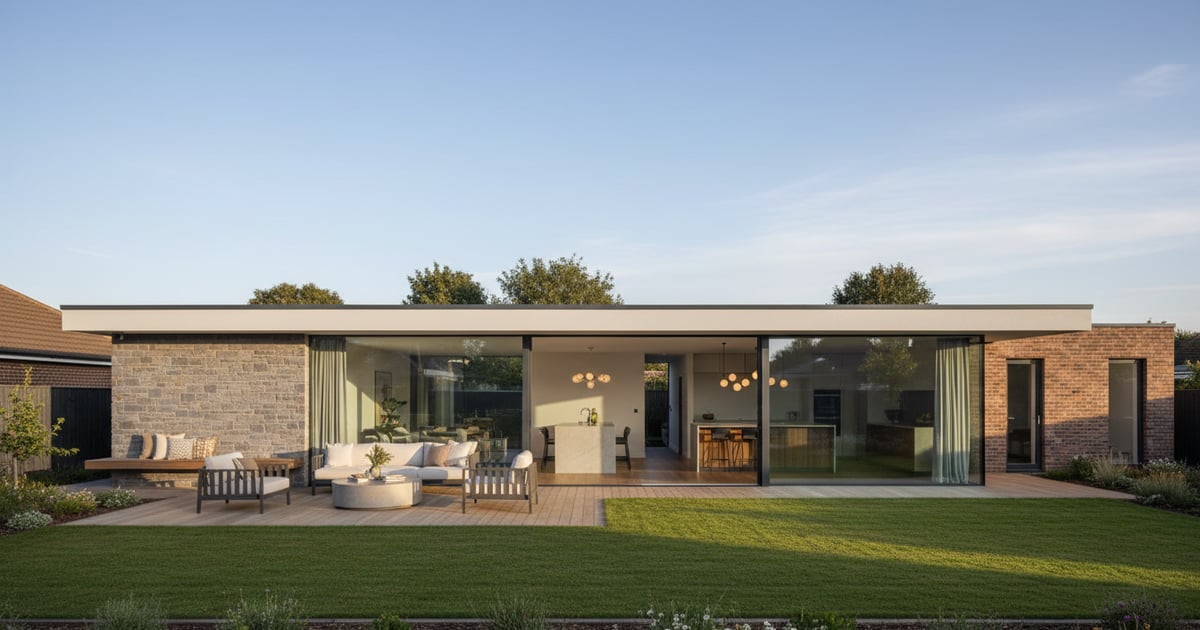
A house extension — also referred to as a home extension or building an addition — is one of the most significant home improvements you can undertake. Whether you're adding a rear extension, a single-storey or double-storey extension, or a wraparound, costs depend on size, specification, structural requirements, and where you live. This guide covers typical UK prices for rear, single-storey, and double-storey extensions to help you plan your budget.
Most projects fall between £54,000 and £90,000. Budget refreshes start near £30,000; premium projects reach up to £264,000.
Two ways to take action on extension costs
Pick the path that fits where you are — running early numbers, or pressure-testing a quote you've already got.
Typical UK Cost by Scenario
Typical timeline: 8 to 16 weeksBudget
£39,000
typical figure
- Basic single-storey footprint increase with standard glazing
- Straightforward finishes
Mid-range
Most common£72,000
typical figure
- Kitchen-diner extension with rooflights
- Good insulation
- Moderate internal reconfiguration
Premium
£204,000
typical figure
- Complex steelwork
- Premium glazing
- Bespoke joinery
Figures are typical UK averages including labour, materials, and VAT at 20% for standard-rated work.
Save money on your quote
Already got a quote from a builder?
Upload it and our AI Quote Checker flags overcharges, missing scope, and the questions worth asking — in about a minute.
Typical UK Cost Ranges for Extension
| Item | Cost Range |
|---|---|
| Single-storey rear (small, 15 m²) | £24,000 – £48,000 |
| Single-storey rear (medium, 25 m²) | £42,000 – £78,000 |
| Single-storey build (per m²) | £1,440 – £3,360 |
| Double-storey (25 m² total) | £54,000 – £84,000 |
| Double-storey (40 m² total) | £72,000 – £114,000 |
| Double-storey build (per m²) | £1,200 – £2,640 |
| Side return extension | £18,000 – £48,000 |
| Wraparound extension | £48,000 – £144,000 |
| Foundations | £3,600 – £12,000 |
| Design and planning | £2,400 – £7,200 |
All prices are approximate UK averages including labour, materials, and VAT at 20% (2026). Some qualifying renovations for empty homes may use the reduced 5% VAT rate.
Mini extension cost calculator
Three quick inputs and we'll email you an indicative range. Run the full calculator for a postcode-adjusted estimate.
Real UK Cost Examples
- Budget scenario (small rear extension, 2-bed terrace, North West): Basic single-storey footprint increase with standard glazing and straightforward finishes. Not done: full internal reconfiguration or premium kitchen fit-out. Approx cost: £25,000 to £40,000.
- Mid-range scenario (3-bed semi rear extension, Bristol): Kitchen-diner extension with rooflights, good insulation and moderate internal reconfiguration. Approx cost: £45,000 to £75,000.
- High-end scenario (wraparound extension, London commuter belt): Complex steelwork, premium glazing, bespoke joinery and major drainage or service relocation. Main cost drivers: structure, glazing package and fit-out. Approx cost: £120,000 to £220,000.
Related next steps:
What You Can Get For Your Budget
- Around £40,000: modest single-storey rear extension with practical specification and limited internal knock-through.
- Around £75,000: larger usable family space with better glazing, rooflights and more integrated internal changes.
- £140,000+: complex geometry, premium envelope, heavy steelwork and full internal layout integration.
Hidden Costs to Watch For
- Foundation depth can increase after ground investigation or Building Control direction.
- Drain diversions and manhole relocations regularly add late-stage civil costs.
- Temporary kitchen or accommodation costs are often omitted from initial budgets.
- Party wall surveyor fees and planning-condition discharges can materially increase soft costs.
Related next steps:
Should You Do This Renovation?
- Usually worth it when space constraints are the main pain point and moving costs are high.
- Less worth it when budget is stretched and similar utility could be achieved by reconfiguring existing rooms.
- Extensions can drive strong long-term value in demand-heavy areas, but payback varies widely by postcode and over-spec risk.
Common Cost Mistakes
- Underestimating preliminaries and site setup in headline per-m² assumptions.
- Changing glazing and rooflight strategy after structural design is fixed.
- Selecting builders on lowest price rather than programme realism and inclusion detail.
- Ignoring a 15% contingency on structural-heavy projects.
Key Cost Factors
- Size and type of extension — single-storey, double-storey, or wraparound.
- Foundations — ground conditions, proximity to trees, and drainage.
- Specification level — basic build vs. high-end finishes.
- Structural requirements — steel beams, underpinning, party wall work.
- Planning permission and building regs — fees and compliance costs.
- Utilities — relocating gas, water, drains, or electrics.
- Finishing and fit-out — kitchen, bathroom, or living space finishes.
Cost per m² by Extension Type
- Rear extension costs are often the baseline due to simpler massing and straightforward planning routes.
- Side returns can be efficient on Victorian terraces but may involve steelwork and drainage diversions.
- Wraparound extensions usually carry the highest totals due to structure, glazing, and full internal reconfiguration.
5 line items every fair extension quote should include
Use this checklist to spot missing scope before you sign — each item names what should be priced and what to ask for if it isn't.
- 1
Architect/designer drawings, structural engineer (IStructE) and Building Control fees
A real extension quote either includes design fees as a separate disbursement line or states clearly they're outside scope. You need: planning drawings (or a Lawful Development Certificate for Permitted Development), Building Regulations drawings, structural engineer calcs (steel beams, foundations) and a Building Control application. A quote that omits all of these is hiding £3,000–£8,000 of unavoidable cost.
Fair UK range: £3,000–£8,000 total. Architect 6–12% of build cost on bespoke schemes; structural engineer £600–£1,800; Building Control £400–£900.
Ask: Are architect, structural engineer and Building Control fees included or excluded — and if excluded, can you give me an indicative figure for each?
- 2
Foundations, substructure and ground works
Foundations are the single biggest variable in extension cost. Standard strip foundations on stable ground cost £3,000–£6,000 for a 25m² extension. Trees within 5m, sloping sites, made-up ground or proximity to drains can force engineered foundations (mini-piles, raft, deeper trench fill) at £8,000–£15,000+. The quote should state the foundation type assumed and what triggers a re-price.
Fair UK range: £3,000–£10,000 for a typical 25m² rear extension on standard ground. Engineered foundations push higher.
Ask: What foundation type have you priced for, and what's the procedure if the trial pit shows different ground conditions?
- 3
Steel beams, structural openings and party wall works
Most extensions involve removing an external wall to open up to the existing house. That means a steel beam (often two), padstones, and sometimes underpinning. If you're attached to a neighbour, the Party Wall etc. Act 1996 applies — you'll need party wall surveyors and possibly an award (£1,200–£3,500 per neighbour). The quote should list steels and confirm whether party wall costs are included.
Fair UK range: Steels: £2,000–£5,000 supplied and fitted. Party wall awards: £1,000–£3,500 per affected neighbour.
Ask: How many steels are included in this price, and have you allowed for party wall surveyor fees if my neighbour appoints one?
- 4
Building envelope — walls, roof, glazing and insulation to Part L
This is the bulk of the build cost. A fair quote names the wall construction (e.g., 'cavity wall, 100mm block + 100mm full-fill insulation + 100mm block + brick outer skin'), the roof type (warm or cold flat roof, tiled pitched roof) and the glazing spec with U-values (for Building Regs Part L compliance). Bifold/sliding doors and rooflights should be itemised separately with brand and size.
Fair UK range: £1,200–£2,800 per m² for shell only depending on spec, glazing area and roof complexity.
Ask: Can you spell out the wall/roof build-up, the U-values you've designed to, and which rooflight/door brands and sizes are priced?
- 5
First and second fix M&E (electrics, plumbing, heating) plus making-good of the existing house
First fix is the cabling, pipework and steel-clad services that go in before plaster; second fix is the sockets, taps, radiators, ceiling lights, etc. A common quote trick is pricing the new room only, then charging extras for tying into the existing consumer unit, boiler upgrade if needed, or knocking through to the kitchen. Making-good of the existing house (re-plastering where the old wall was, redecorating affected rooms) should be a named line.
Fair UK range: £4,000–£10,000 for first and second fix on a 25m² extension. Boiler upgrade £2,000–£3,500 if needed.
Ask: Does this include making good the existing house where works connect, and have you assessed whether the boiler can handle the additional heating load?
Want this run on your actual extension quote? Upload it and our AI Quote Checker flags missing line items, overcharges and the questions worth asking.
7 red flags that mean you might be overcharged on a extension quote
UK-specific signals — each red flag explains why it matters and the question that surfaces the truth.
No mention of architect drawings or 'drawings provided by client'
Why it matters: Without proper drawings (planning + Building Regs), the builder is freelancing the design on site. You'll get scope creep, extras, and a structure that may fail Building Control sign-off. Reputable contractors either work with your architect or recommend one.
Ask: Are you pricing against a full set of Building Regs drawings, and if not, who's producing them?
Vague 'comply with Building Regs' line with no Part L (energy), Part B (fire) or Part K (stairs) detail
Why it matters: 'Building Regs' is a 50+ part document. A real builder names which parts apply to your job and the spec they've priced for: Part L U-values for walls/roof/glazing, Part B fire compartmentation (especially on two-storey or near-boundary), Part K stair geometry if a new staircase is involved.
Ask: Which parts of the Building Regs apply to my build, and what specific spec have you priced to comply?
No Party Wall etc. Act 1996 mention if you're attached or within 6m of a neighbour's foundation
Why it matters: If your extension is on or near a party wall, or excavates within 3m (or 6m for deep foundations), you're legally required to serve a Party Wall Notice. Surveyors and awards add £1,000–£3,500 per affected neighbour. A builder who doesn't raise this either doesn't know the law or hopes you'll absorb it later.
Ask: Have you flagged the party wall implications, and is the cost of surveyors and any award included or excluded?
Day rate or 'time and materials' billing instead of a fixed price
Why it matters: On a project of this size, day rates with no cap shift all overrun risk to you. Reputable extension contractors quote a fixed price against defined drawings, with a stated provisional sum for genuine unknowns (e.g., foundations, drains). T&M with no ceiling on a £50k+ project is a budget grenade.
Ask: Can you give me a fixed price against the drawings, with provisional sums clearly labelled for any genuine unknowns?
No JCT contract offered (or refusal to sign one) on a project over £30,000
Why it matters: JCT (or similar — FMB has a Domestic Building Contract) is the UK industry standard for residential building work. It defines payment schedule, defects liability period, retention, dispute resolution. Builders who refuse a contract are removing your protection if the job goes wrong.
Ask: Will you work under a JCT Minor Works or FMB Domestic Building Contract, and will you accept a 5% retention released at 12 months?
No retention payment terms (typically 5% held for 6–12 months on £30k+ jobs)
Why it matters: Retention protects you against latent defects (cracks, leaks, settlement) that show up after handover. UK norm on extensions is 5% retained, with half released at practical completion and half at 12 months. Builders who insist on 100% on the day deny you any leverage to fix defects.
Ask: Will you accept 5% retention with half released at practical completion and half at 12 months for defects?
Up-front payment over 25% before any work starts
Why it matters: Materials need a deposit (10–20% is normal once construction starts), but anyone asking 30%+ before breaking ground is either undercapitalised or planning to disappear. The standard UK pattern is small deposit, then stage payments tied to defined milestones (foundations complete, watertight, first fix, plaster, completion).
Ask: Can we agree a stage-payment schedule tied to defined milestones, with the deposit capped at 15% before works start?
Spot a couple of these on your extension quote? Upload it for a full red-flag scan and fair-rate comparison.
How to negotiate a extension quote
A simple framework, a verbatim script you can paste into an email or text, and the topic-specific levers that move the price.
Framework
- 1Get three quotes from FMB or TrustMark members against the same set of architect drawings — never let any builder price against a verbal brief, and never compare quotes that have priced different drawings.
- 2Insist on itemised breakdowns: prelims, design fees, foundations, structure, envelope, M&E, fit-out, contingency. A single-line 'extension £52,000' quote tells you nothing and gives you nothing to negotiate against.
- 3Identify the median across the three quotes for each line item. Total quote spread is misleading; what matters is which line items in your preferred builder's quote are above the median and why.
- 4Sit down with your preferred builder (often not the cheapest — chase reliability, references and contract terms over price) and ask them to walk through the line items where they're above the pack. Often they'll price-match on competitive items if you commit to the start date.
Verbatim script
Thanks for the quote — yours is the one we want to go with based on the references and the way you've broken down the drawings. We've had two other quotes from FMB members on the same drawings and yours is competitive overall, but you're £X above the median on foundations and £Y above on the steel package. The other two have priced [specific foundation type / steel sizes] at £Z. Can you walk me through what's included in your figures that justifies the difference, or is there room to match on those items if we're ready to sign the JCT contract this week?
Topic-specific levers
- Foundation type assumption: ask what foundation has been priced and what triggers a re-price. If the builder has assumed engineered foundations 'just in case', you may save £4,000–£8,000 by agreeing to pay for a soil investigation up front and pricing against the actual ground.
- Provisional sums vs fixed price: convert as many provisional sums as possible to fixed prices once drawings are detailed enough — provisional sums almost always inflate during the build.
- Glazing package: bifolds and rooflights are a high-margin line. Get a separate quote from a FENSA-registered installer for the glazing package only and ask the builder to fit client-supplied units (some will, some won't — ask about warranty implications).
- Programme flexibility: if your builder has a gap between projects in 6–10 weeks' time, you can often negotiate 3–5% off in exchange for taking the slot rather than dictating your own timing.
- Staged kitchen/bathroom fit-out: for budgets that are tight, agreeing to take a basic shell now and fit out the kitchen 6 months later (separate trade) can shift £8,000–£15,000 to next year's budget without compromising the build.
Want to know which line items on your extension quote are above market before you negotiate? Upload it for a fair-rate comparison.
10 questions to ask before hiring a extension contractor / main builder
Vet on competence, insurance, paperwork and process — not price alone. Each question spells out the answer you want and why.
1. Are you a member of the Federation of Master Builders (FMB) or TrustMark, and can I see the certificate?
Why it matters: FMB and TrustMark both require independent inspections and adherence to a code of practice. Neither is a quality guarantee, but absence of any third-party accreditation on a £40k+ build is a meaningful gap.
2. Will you work under a JCT Minor Works or FMB Domestic Building Contract, and accept 5% retention?
Why it matters: On any project over £30k, a written contract with retention is industry-standard. Refusal here is the strongest possible signal that the builder is operating outside professional norms.
3. Can I see your structural engineer (IStructE registered)? Do you have a regular SE you work with, or do you expect me to appoint one?
Why it matters: A builder who can name their SE and shows past calculations has done this many times. One who is vague about who'll do the calcs is likely to under-spec the steel and try to fix it on site.
4. Are you VAT registered, and will you provide VAT invoices for every stage payment?
Why it matters: On a £40k+ build the contractor should almost certainly be VAT registered. A non-VAT builder either has a small turnover (less experienced) or is operating cash-only, which forfeits your consumer protection.
5. What level of public liability insurance do you carry — and can I see the certificate?
Why it matters: UK norm for major builds is £5M+ public liability. If a steel goes through a neighbour's roof or your existing house collapses partially, that policy is what saves you from financial ruin. Ask for a copy showing the policy number and renewal date.
6. Can you give me 3 references from completed extensions in the last 12 months — ideally one I can visit?
Why it matters: Recent, local, and ideally one you can physically visit is the gold standard. References from 5 years ago, references the builder won't connect you with, or references in a different region are softer signals.
7. On a two-storey extension, how do you handle Part B (fire) compliance, and have you done two-storey work before?
Why it matters: Two-storey extensions trigger fire compartmentation requirements (especially the floor between storeys, escape windows, and protected escape routes). A builder who shrugs at Part B has likely never had a Building Control inspector challenge them on it.
8. What's your party wall process if my neighbour disputes the Notice or appoints their own surveyor?
Why it matters: A builder who has done many attached-property extensions has a clear answer. Vagueness here means you'll bear the cost and time impact when (not if) a neighbour engages a surveyor.
9. What's your stage payment schedule, tied to which milestones, and what's the maximum overdue period before you'd pause works?
Why it matters: Reputable contractors have a clear schedule (e.g., deposit 10%, foundations 15%, watertight 25%, first fix 20%, plaster 15%, completion 15%) and can show you a sample. Anyone wanting 50% up-front or no schedule at all is a red flag.
10. What's your defects liability period, and how do you handle snagging?
Why it matters: UK norm is a 12-month defects liability period during which the builder returns to fix any latent issues. A builder who only offers 6 months or 'we'll fix anything that comes up' verbally is below standard. Get it in the contract.
Already chosen a extension contractor / main builder and got a quote? Run it through our Quote Checker before you commit.
Typical Timeline
| Item | Duration |
|---|---|
| Design and planning | 4 to 16 weeks |
| Single-storey rear extension | 8 to 12 weeks |
| Double-storey extension | 12 to 16 weeks |
| Wraparound extension | 14 to 20 weeks |
Regional Cost Variations
Extension costs in London are typically 30–50% higher than the national average due to higher labour, material transport, and planning costs. The South East is also above average, while the North and Midlands offer the best value.
Costs in your area
Compare regional benchmarks for house extension using the same UK baseline assumptions.
Ways to Reduce Costs
- Use permitted development rights to avoid planning permission fees where possible.
- Choose a simple rectangular footprint — complex shapes cost more.
- Manage the project yourself if you have experience to save on project management fees.
- Use standard window sizes and materials to reduce lead times and costs.
- Get structural engineer quotes directly rather than through the architect.
Ready to act on your extension project?
Whether you're still scoping or already comparing builders, the next step is one click away.