Loft Conversion Cost UK
Estimate YOUR loft cost in 60 seconds — or check an existing quote against fair UK rates.
Estimates based on UK trade benchmark data, updated 2 May 2026. Methodology →
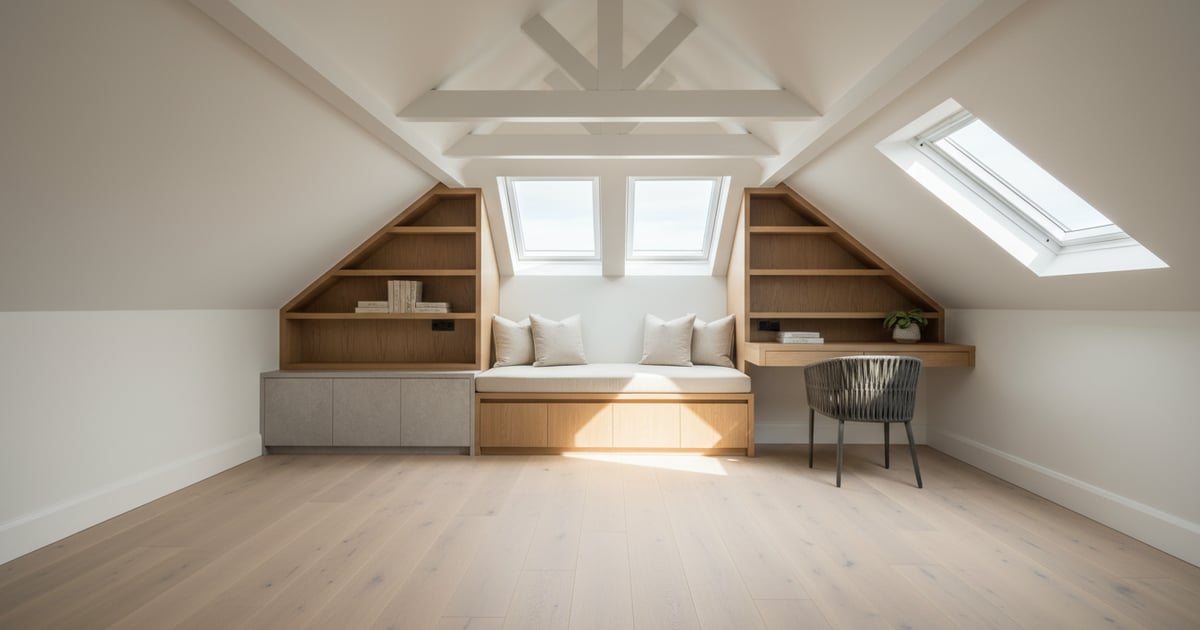
A loft conversion — sometimes called an attic conversion or loft extension — is one of the most effective ways to add living space and value to your home without extending the footprint. Whether you're considering a simple Velux conversion or a full dormer, costs vary significantly based on the type of conversion, your roof structure, and location. This guide covers everything you need to budget effectively.
Most projects fall between £54,000 and £84,000. Budget refreshes start near £24,000; premium projects reach up to £168,000.
Two ways to take action on loft conversion costs
Pick the path that fits where you are — running early numbers, or pressure-testing a quote you've already got.
Typical UK Cost by Scenario
Typical timeline: 4 to 10 weeksBudget
£31,200
typical figure
- Rooflights
- Insulation
- Plaster
Mid-range
Most common£69,000
typical figure
- Balanced specification
- Practical sanitaryware
- New storage joinery
Premium
£135,000
typical figure
- Premium bathroom fit-out
- Bespoke wardrobes
- Upgraded roof structure
Figures are typical UK averages including labour, materials, and VAT at 20% for standard-rated work.
Save money on your quote
Already got a quote from a builder?
Upload it and our AI Quote Checker flags overcharges, missing scope, and the questions worth asking — in about a minute.
Typical UK Cost Ranges for Loft Conversion
| Item | Cost Range |
|---|---|
| Velux / rooflight conversion | £18,000 – £36,000 |
| Dormer loft conversion | £30,000 – £60,000 |
| Hip-to-gable conversion | £36,000 – £72,000 |
| Mansard conversion | £48,000 – £84,000 |
| Staircase installation | £2,400 – £6,000 |
| En-suite in loft | £3,600 – £9,600 |
All prices are approximate UK averages including labour, materials, and VAT at 20% (2026). Some qualifying renovations for empty homes may use the reduced 5% VAT rate.
Mini loft conversion cost calculator
Three quick inputs and we'll email you an indicative range. Run the full calculator for a postcode-adjusted estimate.
Real UK Cost Examples
- Budget scenario (Velux loft conversion, 2-bed terrace, Yorkshire): Rooflights, insulation, plaster, electrics and a simple staircase. Not done: dormer, en-suite or major roof restructuring. Approx cost: £20,000 to £32,000.
- Mid-range scenario (rear dormer with bedroom and shower room, 3-bed semi, Manchester): Balanced specification, practical sanitaryware, new storage joinery and full compliance upgrades. Approx cost: £45,000 to £70,000.
- High-end scenario (L-shaped dormer in a period property, London): Premium bathroom fit-out, bespoke wardrobes, upgraded roof structure and full fire-compliance package. Main cost drivers: structural complexity, access and finish level. Approx cost: £85,000 to £140,000.
Related next steps:
What You Can Get For Your Budget
- Around £30,000: straightforward Velux conversion focused on one extra room and basic finishes.
- Around £60,000: dormer conversion with much better usable space and potential for a compact bathroom.
- £100,000+: complex lofts with premium joinery, bathroom quality, stronger structural intervention and architectural detailing.
Hidden Costs to Watch For
- Staircase geometry constraints can trigger extra design and structural revisions.
- Fire door, alarm and escape upgrades on lower floors are often overlooked early.
- Roof strengthening and steel requirements vary more than homeowners expect.
- Scaffolding duration extensions can add cost if programme slips.
Related next steps:
Should You Do This Renovation?
- Worth it in many urban homes where footprint expansion is limited but roof volume is usable.
- Not worth forcing when head height and staircase constraints create compromised room quality.
- Lofts can add strong value when they create a true extra bedroom and compliant bathroom, not just occasional space.
Common Cost Mistakes
- Assuming all loft types cost similar regardless of roof shape and access.
- Underbudgeting for full compliance upgrades beyond the loft itself.
- Changing dormer size or window package mid-design.
- Picking on price without checking structural engineer coordination and sequencing.
Key Cost Factors
- Type of conversion — Velux is cheapest; mansard is most expensive.
- Roof structure — trussed roofs require more structural work than traditional rafters.
- Planning permission — dormers at the rear under permitted development; front and mansard usually need planning.
- Party wall agreements — required for terraced and semi-detached properties.
- Staircase location — affects the layout and usable space on the floor below.
- Building regulations — fire safety, insulation, and structural calculations are mandatory.
- Services — electrics, plumbing (if adding en-suite), and heating.
Dormer vs Velux Cost Comparison
- Velux-only loft conversions are usually cheaper where head height is already adequate.
- Dormer conversions increase usable floor area and resale utility but add structural and weatherproofing cost.
- Stair positioning and fire-compliance upgrades often decide final affordability more than window choice alone.
5 line items every fair loft conversion quote should include
Use this checklist to spot missing scope before you sign — each item names what should be priced and what to ask for if it isn't.
- 1
Structural design and structural engineer fees
Every loft conversion alters roof loads. A structural engineer (IStructE-registered) calculates the new floor joists, ridge beam, dormer steelwork (if any) and how the existing roof transfers loads. This is non-negotiable; a quote without it is a red flag.
Fair UK range: £800–£2,000 for engineering calculations on a typical conversion. Expect £1,500–£3,500 for architect drawings.
Ask: Are structural engineer fees and architect drawings included separately, and what's the engineer's name?
- 2
Building Regulations application + Building Control inspections
Loft conversions require Building Regs approval (Full Plans submission preferred over Building Notice). Building Control inspects at key stages: foundations/structure, insulation, fire protection, completion. Fees vary by council but should be itemised.
Fair UK range: £600–£1,200 for council Building Control fees on a standard loft conversion.
Ask: Is the Building Regs application a Full Plans submission, and are inspection fees itemised?
- 3
Fire safety upgrades (Part B compliance)
Adding a habitable room above two existing storeys triggers Part B fire regs: 30-minute fire-rated doors on all rooms opening onto the new escape stairwell, sometimes mains-wired smoke alarms throughout. This is often forgotten in cheap quotes and added as 'extras' later.
Fair UK range: £800–£1,800 for fire-rated doors throughout escape route + interlinked smoke/heat alarms.
Ask: Are fire-rated doors and Part B compliance included for the full escape route, not just the loft?
- 4
Insulation to current Part L standards
New roof and walls must hit Part L thermal performance — typically 270mm mineral wool between/over rafters for a warm roof, or 150mm PIR rigid board. This is materials + labour heavy and should be a clear line, not bundled.
Fair UK range: £40–£70 per m² of roof/wall area for Part L compliant insulation including materials and fitting.
Ask: What insulation system are you using, what's the U-value target, and is it itemised separately?
- 5
Staircase: design, build and Part K compliance
The new staircase must meet Part K (steepness, headroom, balustrades). On constrained sites, space-saving stairs (alternating tread) need building control approval. The staircase often eats more square footage downstairs than people expect.
Fair UK range: £1,500–£4,000 for a standard timber staircase; £4,000–£8,000+ for bespoke or steel.
Ask: Is the staircase design Part K compliant, and how much downstairs floor space does the new run consume?
Want this run on your actual loft conversion quote? Upload it and our AI Quote Checker flags missing line items, overcharges and the questions worth asking.
7 red flags that mean you might be overcharged on a loft conversion quote
UK-specific signals — each red flag explains why it matters and the question that surfaces the truth.
No structural engineer named on the quote
Why it matters: A loft conversion without proper structural calculations is dangerous and unmortgageable. Reputable contractors name their engineer; vague 'structural will be sorted' answers usually mean a 'mate who does drawings' rather than an IStructE professional.
Ask: Who is the structural engineer, are they IStructE registered, and can you share their PI insurance details?
Quote significantly below £1,500/m² for a dormer conversion
Why it matters: UK 2026 typical for dormer is £1,700–£2,500/m². Below £1,500/m² usually means: corner-cutting on insulation, no proper fire compliance, sub-standard staircase, or a contractor who underbid and will hit you with extras.
Ask: Can you walk me through how you've achieved this price? What's the spec on insulation, fire compliance, and staircase?
No Permitted Development check before applying for planning
Why it matters: Many loft conversions fall under Permitted Development (no planning application needed), saving £462 application fee + 8 weeks. A contractor who pushes straight to planning hasn't checked. Equally, conservation areas often DON'T have PD rights — a contractor unaware will waste your time.
Ask: Is this conversion within Permitted Development limits? If so, will you apply for a Lawful Development Certificate (£103) for resale protection?
Vague 'finishes' line bundling kitchen-spec items
Why it matters: If the loft includes an ensuite, 'finishes' should specify: tile spec, sanitaryware brand, taps, lighting. Without itemisation, you get whatever the contractor's mate has on the van — usually the cheapest available.
Ask: Can you itemise the ensuite finishes — tiles, sanitaryware, taps, lighting — by brand and product?
No Party Wall Award mentioned for terraced or semi-detached
Why it matters: Loft conversions on attached homes almost always trigger the Party Wall etc. Act 1996. Awards take 4–8 weeks and cost £700–£1,500. A contractor who doesn't mention it is either inexperienced or hoping you won't notice — until your neighbour serves notice mid-build.
Ask: Will this trigger the Party Wall Act, and have you allowed for surveyor fees and timing in your programme?
No fire escape route detailed in the design
Why it matters: Building Regs Part B requires a protected escape route — typically the existing staircase enclosed in fire-rated doors all the way to the front door. If the design doesn't show this, the conversion will fail Building Control sign-off.
Ask: Show me the protected fire escape route on the drawings — every door from the loft to the front door must be 30-minute fire-rated.
Payment schedule with more than 25% upfront
Why it matters: Loft conversions are 8–12 week projects with material spend spread across the timeline. A 50% upfront demand is a structural risk — if the contractor goes bust mid-job, you're an unsecured creditor. Industry norm: stage payments tied to verifiable milestones.
Ask: Can we agree stage payments tied to milestones (structure complete, first fix complete, etc.) with no more than 20% upfront?
Spot a couple of these on your loft conversion quote? Upload it for a full red-flag scan and fair-rate comparison.
How to negotiate a loft conversion quote
A simple framework, a verbatim script you can paste into an email or text, and the topic-specific levers that move the price.
Framework
- 1Get three quotes from FMB-registered loft specialists for an identical spec: same conversion type (Velux/dormer/hip-to-gable/mansard), same usable area, same finish level, ensuite y/n. Without identical scope, the quotes can't be compared.
- 2Demand itemised breakdowns including: structural design, Building Regs, build, fire compliance, staircase, ensuite (if applicable), and finishes. A single-total quote is unworkable on a £40k+ project.
- 3Identify the median per major line. The total spread on loft conversions is often £20k+ across three quotes — meaningless. The line-item spread tells you who's cutting corners.
- 4Insist on a JCT Minor Works contract (or similar) for the project. This caps payment terms, defines variations, and gives you legal recourse. Reputable specialists welcome this; cowboys don't.
Verbatim script
I've had three quotes for this loft conversion. Yours is competitive overall, but the structural design line is £X above the median, and the finishes line is £Y below. The other quotes specify [brand/spec] for sanitaryware and 270mm warm-roof insulation. Can you walk me through how your spec compares, and let me know if you're willing to use a JCT Minor Works contract with stage payments tied to milestones?
Topic-specific levers
- Project management fee: some specialists charge 10–15% PM on top of build cost, others bake it in. Ask for the breakdown — sometimes self-managing with separate trades is 20% cheaper.
- Architect-supplied drawings vs. contractor's: if you've already paid an architect for drawings, ensure the contractor's quote excludes design fees, not duplicates them.
- Material specification: 'standard' insulation is sometimes minimum-spec wool that just hits Part L. Premium PIR boards cost 20% more but reduce heating bills meaningfully.
- Bathroom spec downgrade: if budget is tight, downgrading from £600 sanitaryware to £300 saves £1,500–£2,500 on a typical ensuite without compromising function.
- Staircase compromise: bespoke timber stairs cost £3,000+; off-the-shelf compliant stairs cost £800–£1,200. Decide what visible joinery quality matters.
Want to know which line items on your loft conversion quote are above market before you negotiate? Upload it for a fair-rate comparison.
10 questions to ask before hiring a loft conversion specialist
Vet on competence, insurance, paperwork and process — not price alone. Each question spells out the answer you want and why.
1. Are you a member of the FMB (Federation of Master Builders) or the National Federation of Builders?
Why it matters: FMB members are vetted financially and on workmanship. They also offer FMB Insurance-Backed Warranties. Membership isn't legally required, but absence + no other body membership is a softer signal.
2. Can you show me two or three completed loft conversions in this region from the last 12 months?
Why it matters: Loft work has a long failure tail — issues appear at 12+ months. Recent local references let you visit (or at least photograph) actual completed work and ideally speak to past clients.
3. Who's your structural engineer, and are they IStructE-registered?
Why it matters: Structural engineering on lofts is critical and regulated. The engineer should be IStructE registered with current PI insurance. Vague 'we'll get one' answers mean the contractor doesn't have an established relationship.
4. What contract are you proposing — JCT Minor Works, JCT Home Owner, or your own terms?
Why it matters: JCT contracts are industry standard, define payment terms, variations, and dispute resolution. Contractors offering only 'their own terms' usually have less protection for you.
5. What's your payment schedule, and what milestones trigger each stage?
Why it matters: Stage payments tied to verifiable milestones (structure complete, first fix complete, etc.) protect you if the contractor goes bust. Calendar-based payments don't.
6. Will you handle the Building Regs application as Full Plans, and arrange Building Control inspections?
Why it matters: Full Plans is preferable to Building Notice for lofts (you get a written approval before work). Some contractors prefer Building Notice (less paperwork, more risk).
7. How will you protect existing rooms from dust during construction?
Why it matters: Loft work generates massive amounts of dust and creates an open hole in your roof for weeks. Reputable contractors use proper dust screens and weather-tight scaffolding/protection. Vague answers mean ruined carpets.
8. What's the warranty on the workmanship, and is it insurance-backed?
Why it matters: Industry norm: 10-year insurance-backed warranty (FMB IBG, BuildSure, etc.) for structural; 12–24 months for other workmanship. Verbal-only warranties are worthless if the contractor goes bust.
9. How do you handle variations (changes after work starts), in writing?
Why it matters: Variations are where projects bleed budget. A reputable contractor uses signed variation orders with prior approval; cowboys verbally agree and add to the final invoice.
10. Are you VAT registered, and what's your public liability cover?
Why it matters: VAT registration matters for invoicing and warranty enforcement. Public liability of £5M minimum is industry norm for £40k+ projects (£2M is bare minimum). Ask to see certificates.
Already chosen a loft conversion specialist and got a quote? Run it through our Quote Checker before you commit.
Typical Timeline
| Item | Duration |
|---|---|
| Velux / rooflight conversion | 3 to 5 weeks |
| Dormer conversion | 5 to 8 weeks |
| Mansard conversion | 8 to 12 weeks |
Regional Cost Variations
Loft conversions in London typically cost 20–40% more than national averages due to higher labour rates and the prevalence of Victorian terraces requiring party wall agreements. Northern England and Scotland tend to be more affordable.
Costs in your area
Compare regional benchmarks for loft conversion using the same UK baseline assumptions.
Ways to Reduce Costs
- Choose a Velux conversion if you don't need maximum headroom.
- Get at least three detailed quotes and compare scope, not just price.
- Do finishing work (painting, flooring) yourself after the structural work is complete.
- Avoid moving the staircase if possible to reduce structural changes.
- Consider pre-fabricated dormers which can reduce on-site build time.
Ready to act on your loft conversion project?
Whether you're still scoping or already comparing builders, the next step is one click away.