Flooring Renovation Cost UK
Get YOUR cost in 60 seconds — or check an existing quote against fair UK rates.
Estimates based on UK trade benchmark data, updated 2 May 2026. Methodology →
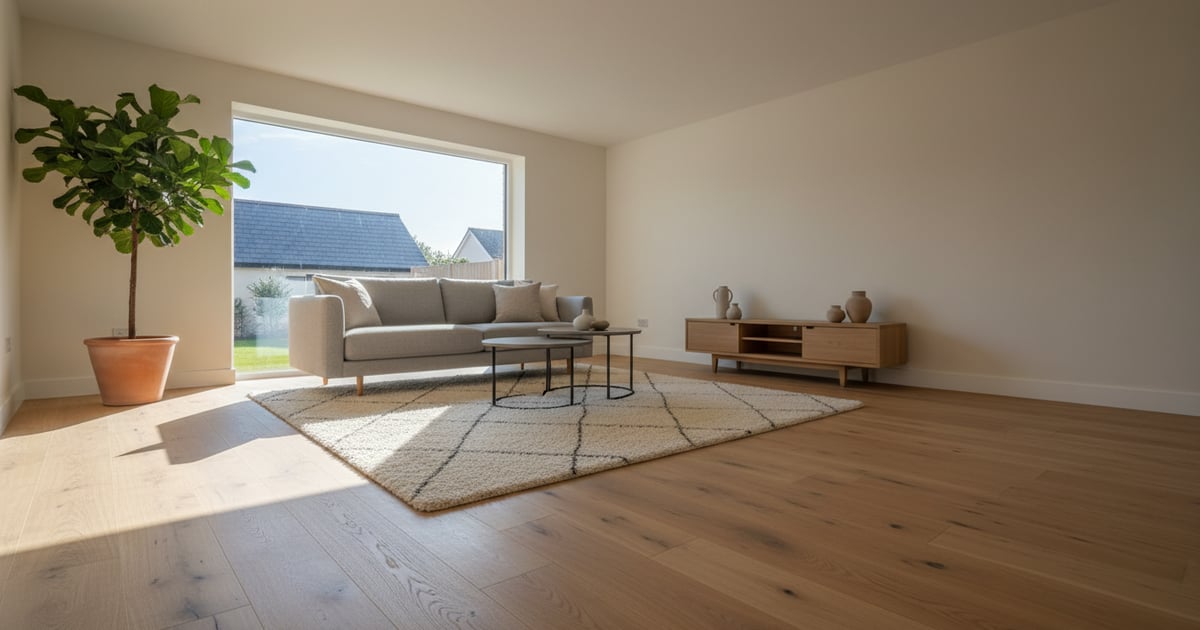
A flooring renovation can transform how a home looks and feels. Whether you’re planning a full floor replacement, new installation, or professional floor fitting across several rooms, the UK market spans budget laminate and LVT through engineered wood and stone tile. Material choice, room size, subfloor condition, and whether you hire a fitter all drive the final flooring renovation cost.
Most projects fall between £2,550 and £3,450. Budget refreshes start near £570; premium projects reach up to £10,080.
Two ways to take action on flooring costs
Pick the path that fits where you are — running early numbers, or pressure-testing a quote you've already got.
Typical UK Cost by Scenario
Typical timeline: 1 to 5 daysBudget
£1,486
typical figure
- Focused essentials
- Practical finishes
Mid-range
Most common£3,000
typical figure
- Balanced specification with core upgrades
- Reliable materials
Premium
£6,840
typical figure
- Premium materials
- Wider scope with higher coordination demands
Figures are typical UK averages including labour, materials, and VAT at 20% for standard-rated work.
Save money on your quote
Already got a quote from a builder?
Upload it and our AI Quote Checker flags overcharges, missing scope, and the questions worth asking — in about a minute.
Typical UK Cost Ranges for Flooring
| Item | Cost Range |
|---|---|
| Laminate flooring (per m²) | £10 – £42 |
| Engineered hardwood (per m²) | £30 – £108 |
| Luxury vinyl tile (per m²) | £18 – £66 |
| Ceramic / porcelain tiles (per m²) | £24 – £96 |
| Carpet (per m²) | £7 – £60 |
| Fitting labour (per m²) | £10 – £36 |
All prices are approximate UK averages including labour, materials, and VAT at 20% (2026). Some qualifying renovations for empty homes may use the reduced 5% VAT rate.
Mini flooring cost calculator
Three quick inputs and we'll email you an indicative range. Run the full calculator for a postcode-adjusted estimate.
Real UK Cost Examples
- Budget scenario (3-bed terrace, Manchester): focused essentials and practical finishes. Not done: major layout or structural changes. Approx cost: £475 to £2,000.
- Mid-range scenario (typical homeowner, 4-bed detached): balanced specification with core upgrades and reliable materials. Approx cost: £2,125 to £2,875.
- High-end scenario (bungalow): premium materials and wider scope with higher coordination demands. Main cost drivers: specification level and complexity. Approx cost: £3,000 to £8,400.
Related next steps:
What You Can Get For Your Budget
- Around £1,750: core refresh and essential upgrades, usually with no major layout change.
- Around £2,500: balanced refit scope with better materials and targeted performance improvements.
- £3,750+: wider flexibility on finish quality, scope depth, and more complex works.
Hidden Costs to Watch For
- Subfloor levelling and moisture mitigation can materially increase fit-out costs.
- Waste removal, making-good, and repeat trade visits are common late-budget increases.
- Compliance and certification items are often missing from initial summary quotes.
- In most UK projects, scope changes after works start are where costs escalate fastest.
Related next steps:
Should You Do This Renovation?
- Usually worth it when flooring solves a clear usability, compliance, or energy-performance problem.
- Less worth it when the main issue is cosmetic and resale timing is short-term.
- ROI is strongest when scope is disciplined and specification matches local value levels.
Common Cost Mistakes
- Underestimating labour and preliminaries while focusing only on material prices.
- Changing scope mid-project without budget re-baselining.
- Choosing the cheapest quote without checking detailed inclusions and exclusions.
- Running too little contingency for hidden defects and compliance upgrades.
Key Cost Factors
- Material choice — laminate is cheapest; natural stone is the most expensive.
- Room size and shape — large, open areas are cheaper per m² than small, complex rooms.
- Subfloor preparation — levelling, damp-proof membranes, and underlay add cost.
- Underfloor heating — compatible materials required; adds £30–£60 per m².
- Pattern and waste — herringbone and diagonal patterns generate more waste.
- Removal of existing flooring — skip hire and labour for old floor removal.
- Threshold bars and finishing — skirting boards, trims, and transitions.
Cost Checkpoints
Use these checkpoints to sequence spend decisions, protect your core scope, and reduce late-stage budget overruns.
- Prioritise engineered hardwood (per m²) first: typical range £30 to £108 can shift the whole project budget if scope changes late.
- Prioritise ceramic / porcelain tiles (per m²) next: typical range £24 to £96 can shift the whole project budget if scope changes late.
- Use £2.5k as a working midpoint and hold a contingency of roughly 10% to 15% for unknowns and making-good works.
- Request like-for-like quotes with labour, materials, and exclusions split out so you can compare options without hidden scope gaps.
5 line items every fair flooring quote should include
Use this checklist to spot missing scope before you sign — each item names what should be priced and what to ask for if it isn't.
- 1
Subfloor inspection and preparation
Before any flooring goes down, the substrate has to be flat, dry and stable. Quotes should cover inspection, levelling compound where needed, and damp-proof membrane on ground floors. Skipping this is the #1 reason new flooring fails within 18 months.
Fair UK range: £8–£15 per m² on a normal subfloor. Higher only if major levelling or moisture work is needed.
Ask: Can you break out subfloor preparation as a separate line item, with specific products?
- 2
Material specification — brand, range and quantity
A fair quote names the actual product: brand, range, thickness, AC rating (laminate) or wear layer (LVT). It also lists the quantity in m² with a stated waste allowance (typically 8–12% for plank, 12–18% for diagonal or herringbone).
Fair UK range: Material cost varies by spec. Generic 'flooring materials' line items are a red flag.
Ask: Which exact product and range are you quoting, and what's the waste allowance you've calculated?
- 3
Underlay or moisture barrier
Laminate, engineered wood and LVT all need the right underlay or membrane underneath. Concrete floors below DPC need a separate moisture barrier. The right spec varies by material and substrate — it should be itemised, not bundled.
Fair UK range: £3–£8 per m² for premium acoustic underlay; £2–£5 per m² for moisture barrier.
Ask: What underlay are you specifying and why is it right for this substrate?
- 4
Removal and disposal of existing flooring
Lifting old flooring, breaking up adhesive or screed, and skip hire / waste transfer notes are real costs that should be clearly priced — not buried in a vague 'preparation' total.
Fair UK range: £8–£18 per m² depending on existing material. Carpet is cheap; tile or screed is the high end.
Ask: Is the price for removal and disposal listed separately, and does it include skip or waste transfer?
- 5
Beading, thresholds, transitions and skirting reinstatement
Most jobs need at least beading or quadrant trim, threshold/door bars between rooms, and sometimes skirting board removal and refit. These are the items most often added later as 'extras' — they should be in the original quote.
Fair UK range: £150–£500 total for an average 3-room job, depending on which items apply.
Ask: Are thresholds, beading and skirting reinstatement included, and which trims are you proposing?
Want this run on your actual flooring quote? Upload it and our AI Quote Checker flags missing line items, overcharges and the questions worth asking.
7 red flags that mean you might be overcharged on a flooring quote
UK-specific signals — each red flag explains why it matters and the question that surfaces the truth.
'Materials' bundled into one line item with no brand or m² spec
Why it matters: Without the actual product name, you can't price-check the material cost yourself or know what wear layer/quality you're getting. It's the easiest place to mark up 30%+ unnoticed.
Ask: Can you itemise materials by product name, range and quantity in m²?
Subfloor preparation over £15/m² on a level concrete floor
Why it matters: Standard prep on a flat, dry subfloor takes 1–2 hours per 20m² and shouldn't exceed £8–£12/m². Higher figures are justified only when there's serious levelling or remediation work.
Ask: Can you show me what specific subfloor issues you're addressing and why the prep cost is at this level?
Day rate billing instead of fixed price for a defined area
Why it matters: For flooring with a defined m² scope, a fair fitter quotes a fixed total. Day rates with no cap shift all the cost risk to you — overruns become your problem, not the fitter's.
Ask: Can you give me a fixed price for the defined area, with a stated allowance for unforeseen subfloor issues?
No moisture testing mentioned for ground floors or below DPC
Why it matters: Wood, LVT and laminate fail when laid on a damp substrate. Any reputable fitter will test moisture levels before installation; if it's not in the quote, it's not happening.
Ask: Will you carry out a moisture test before laying, and what's the threshold you'll halt the job at?
Vague 'making good' or 'finishing' charge without itemisation
Why it matters: 'Making good' is a phrase that swallows hidden costs. A clean quote names what's being made good: skirting refit, threshold bars, door trimming, bead fitting — each with a price.
Ask: Can you list exactly what 'making good' covers and break out the cost per item?
No threshold, beading or skirting line item
Why it matters: Most flooring jobs need at least £150–£500 of finishing trim. If it's missing from the quote entirely, it's almost always added mid-job as an 'extra' you can't refuse without an unfinished job.
Ask: Are thresholds, beading and skirting reinstatement included in this price, or will they be charged separately?
No quote validity period (fair quotes commit for 30+ days)
Why it matters: Without a stated validity, the fitter can quietly increase the price between quote and job start, claiming material price rises. Reputable fitters commit to their quote for at least 30 days.
Ask: How long is this quote valid for, and what happens to the price if I confirm in 2 weeks?
Spot a couple of these on your flooring quote? Upload it for a full red-flag scan and fair-rate comparison.
How to negotiate a flooring quote
A simple framework, a verbatim script you can paste into an email or text, and the topic-specific levers that move the price.
Framework
- 1Get three quotes for the exact same scope: same area in m², same material brand and range, same removal/prep requirements. If the scope drifts, the quotes can't be compared.
- 2Request itemised breakdowns from all three. Reject anyone who only gives you a single total — that opacity is itself a problem.
- 3Identify the median price for each line item across the three quotes. Total quote spread is less useful than line-item spread — that's where the inflation is.
- 4Go back to your preferred fitter (often not the cheapest — chase reliability, not just price) and ask them to price-match the median on individual high-spread items.
Verbatim script
I've had three quotes for this work and yours is competitive overall, but it's £X above the median on subfloor preparation and material supply. The other two are quoting [specific brand/spec] at £Y/m². Can you walk me through what's included in your line items that justifies the difference, or match the median if it's the same spec?
Topic-specific levers
- Supply-only vs supply-and-fit: you can buy materials from Carpetright/Wickes/Floorbay yourself at trade prices and pay the fitter labour-only — typically 15–25% saving, but you carry the waste-allowance risk.
- Off-cut waste percentage: ask if you can use leftovers for cupboards or smaller rooms instead of paying for more material than needed.
- Like-for-like material substitutes: an 8mm laminate can perform almost identically to a 12mm version at half the price for low-traffic rooms.
- Fitting day timing: mid-week fitters often have gaps to fill; ask about a small discount for flexible scheduling.
- Skip the underlay upgrade if your subfloor is concrete and you've used a separate moisture barrier — premium acoustic underlay is genuinely useful upstairs but rarely needed downstairs.
Want to know which line items on your flooring quote are above market before you negotiate? Upload it for a fair-rate comparison.
10 questions to ask before hiring a flooring fitter
Vet on competence, insurance, paperwork and process — not price alone. Each question spells out the answer you want and why.
1. Are you a member of NICF (National Institute of Carpet & Floorlayers) or CFA (Contract Flooring Association)?
Why it matters: Membership requires assessed competence, insurance evidence and adherence to a code of conduct. Not the only signal of quality, but absence + no other credentials is worth a second thought.
2. Can you provide 2–3 references from jobs in the last 6 months in this region?
Why it matters: Recent local references let you actually verify quality and reliability. Old or out-of-area references are a softer signal.
3. What's your subfloor moisture testing process before installing wood, LVT or laminate?
Why it matters: A reputable fitter has a clear answer: hygrometer reading, threshold levels, what happens if it fails. Vagueness here means failures down the line.
4. What's your installation warranty, in writing?
Why it matters: UK norm is 12–24 months on workmanship (separate from the manufacturer's material warranty). Anything less than 12 months is below standard.
5. How do you handle unexpected subfloor issues mid-job — fixed extra rate or time-and-materials?
Why it matters: You want a stated extra-works rate (e.g., '£X per hour for additional levelling, agreed before any work proceeds') — not an open-ended T&M arrangement that ratchets the bill.
6. Are materials at trade prices passed through, or are they marked up?
Why it matters: Some fitters mark up materials 20–40% on top of their trade discount. Others pass them through and charge labour only. Knowing which arrangement you're in shapes the negotiation.
7. Do you handle skirting reinstatement and threshold/door bar work, or is that a separate trade?
Why it matters: If it's separate, you need to coordinate two trades or end up with an unfinished room. Sort out scope before the job starts.
8. What's your payment schedule?
Why it matters: UK industry norm: small deposit (10–20%) for materials, balance on completion. Anything over 25% upfront, or 50% before work starts, is a structural risk.
9. Are you VAT registered, and will you provide a proper VAT invoice?
Why it matters: VAT registration matters for warranty enforcement and (for some renovation works) lets you reclaim VAT. Cash-only or no-invoice arrangements forfeit consumer protection.
10. Do you carry public liability insurance, and at what level?
Why it matters: UK norm is £2M minimum public liability. If the fitter damages your property or worse, that insurance is what covers you. Ask to see the certificate, not just the answer.
Already chosen a flooring fitter and got a quote? Run it through our Quote Checker before you commit.
Typical Timeline
| Item | Duration |
|---|---|
| Single room (laminate/vinyl) | 1 day |
| Full ground floor | 2 to 3 days |
| Whole house tiling | 3 to 5 days |
Regional Cost Variations
Flooring installation costs are relatively consistent across the UK, though London fitters charge 10–20% more. Material costs are similar nationwide if purchased online.
Costs in your area
Compare regional benchmarks for flooring renovation using the same UK baseline assumptions.
Ways to Reduce Costs
- Choose laminate or LVT instead of hardwood for a similar look at lower cost.
- Buy flooring in bulk or during sales for significant discounts.
- Fit click-lock flooring yourself — it's one of the easier DIY flooring options.
- Use remnants or off-cuts for small rooms or cupboards.
- Prepare the subfloor yourself to reduce labour charges.
Ready to act on your flooring project?
Whether you're still scoping or already comparing builders, the next step is one click away.